Barcelona, Spain

May 2016


Barcelona, Spain

Construction on the Sagrada Família began in 1882, and Gaudí took it over a year later. He designed the Nativity façade himself, with flowing, organic stone full of life, while the Passion façade came later, with sculpture by Josep Maria Subirachs that is sharp and angular to evoke suffering. The central tower was finished on the outside in February 2026, but the church as a whole is still not complete.

Looking up at the richly carved Nativity façade and four towers of the Sagrada Família in Barcelona, with construction cranes above.

The Nativity façade of the Sagrada Família, the ornate east front begun in 1891. It is the façade most closely tied to Gaudí’s own lifetime; the Nativity façade and crypt were added to UNESCO’s “Works of Antoni Gaudí” listing in 2005.
The Passion façade of the Sagrada Família in Barcelona, with angular stone sculptures of the Crucifixion and other Passion scenes above the doorways.

The Passion façade of the Sagrada Família, with angular sculpture by Josep Maria Subirachs (commissioned in 1986) depicting the Crucifixion and the events of the Passion.
The undulating stone façade of Casa Milà, also called La Pedrera, on a tree-lined corner of Passeig de Gràcia in Barcelona.

Casa Milà (La Pedrera), Gaudí’s last private residential building, designed for Pere Milà and Rosario Segimon and built in 1906–1912. UNESCO listed it as a World Heritage Site in 1984.
The mosaic façade of Casa Batlló in Barcelona, with bone-like stone columns, mask-shaped balconies, and a scaly roof topped by a four-armed cross.

Casa Batlló, on Passeig de Gràcia. Gaudí renovated the 1877 building for Josep Batlló in 1904–1906. It has been part of UNESCO’s “Works of Antoni Gaudí” World Heritage listing since 2005.
Gothic ribbed vaults and a carved stone choir screen inside Barcelona Cathedral, looking through to the high altar.

Inside Barcelona Cathedral (the Cathedral of the Holy Cross and Saint Eulalia), looking through the choir toward the high altar. This is the city’s Gothic cathedral, not the Sagrada Família.
Mark standing on a palm-lined promenade in Barcelona, with the brick Arc de Triomf at the far end of the walk.

On Passeig de Lluís Companys, with Barcelona’s Arc de Triomf in the background.
Mark standing with both arms raised in front of the two brick Venetian Towers at Plaça d’Espanya in Barcelona.

In front of the Venetian Towers (Torres Venecianes) at Plaça d’Espanya.
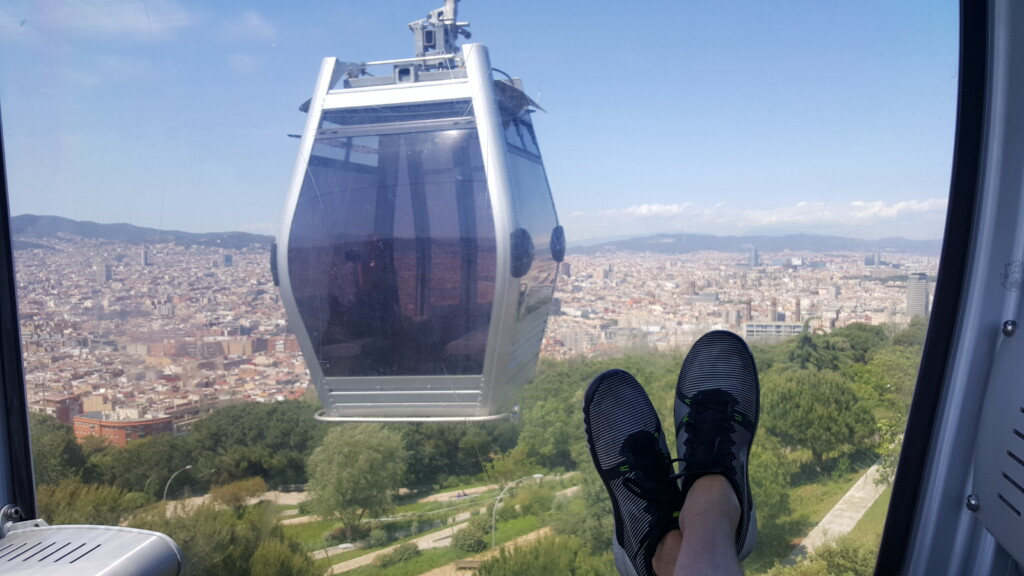
View over the city of Barcelona from inside a cable-car cabin, with another cabin passing and a park on the hillside below.

Looking out over Barcelona from the Telefèric de Montjuïc cable car.
Mark standing at dusk in front of the ornate brick and tile façade of La Monumental bullring in Barcelona.

Outside La Monumental (Plaza de Toros Monumental) in Barcelona.
A white and grey three-wheel Peugeot scooter parked on cobblestones outside a scooter and bike rental shop.

I road this three-wheel Peugeot scooter all over Barcelona. The first 15 minutes of riding it was crazy, because I almost crashed and got honked at several times. After that, all was great!
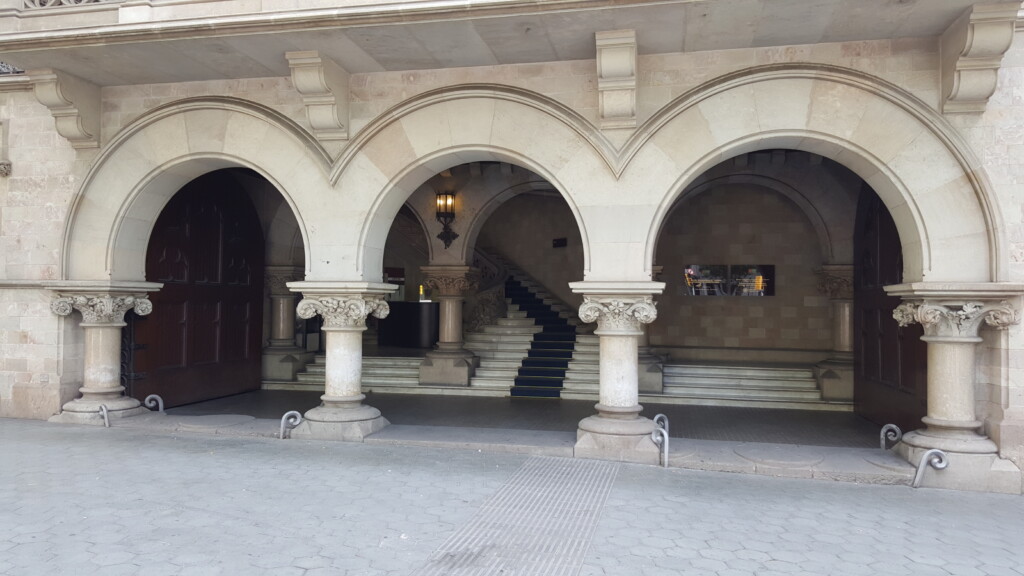
A stone arcade of four arches with carved capitals, heavy wooden doors at the sides, and a staircase visible in the center.

A stone arcade with carved capitals and a staircase beyond, in Barcelona. The exact building is uncertain.
A kinetic metal sculpture made of bicycle wheels, drums, a banjo, cymbals, and horns in a white-walled museum gallery.

A kinetic sculpture of bicycle wheels, drums, and found instruments in a museum gallery. The museum and the artist are uncertain.
Mark posing, visible through a burnt opening in a contemporary photographic artwork hanging on a museum wall.

Posing with a contemporary artwork in a Barcelona museum. The museum and the artist are uncertain.

A short history of the Gaudí buildings in these photos

This background is separate from the trip story above. It is a short factual summary from official sources, for context, and can be edited or removed.

The Basílica de la Sagrada Família was begun in 1882 to a neo-Gothic design by Francisco de Paula del Villar. Bishop José María Urquinaona laid the cornerstone on 19 March 1882. Antoni Gaudí took over as architect on 3 November 1883 and recast the project as a much larger church, a “Bible in stone.” He worked on it exclusively from 1914 until his death on 10 June 1926; the only tower he saw finished was the Saint Barnabas bell tower on the Nativity façade, completed in 1925.

The Nativity façade, begun in 1891, is the ornate east front most closely tied to Gaudí’s lifetime. In 2005 that façade and the crypt were added to UNESCO’s “Works of Antoni Gaudí” World Heritage listing. The Passion façade, shown here with sculpture by Josep Maria Subirachs (commissioned in 1986), depicts the Crucifixion and the events of the Passion. Pope Benedict XVI consecrated the church as a minor basilica on 7 November 2010.

The basilica is still unfinished. On 20 February 2026 the upper arm of the cross was placed on the Tower of Jesus Christ, completing the exterior of the central tower at 172.5 metres — the Temple’s highest point — and finishing the exterior of the six central towers. Interior work on that tower is scheduled to continue in 2027 and 2028. On 10 June 2026, the centenary of Gaudí’s death, Pope Leo XIV celebrated mass and blessed the tower, which was then lit for the first time. The official Sagrada Família site does not give a firm date for completing the whole basilica. In September 2025 the building committee said it hoped the work could be finished in about ten years if conditions held, with the Glory façade still to come.

Casa Batlló, on Passeig de Gràcia, is an 1877 building that Gaudí fully renovated for Josep Batlló in 1904–1906. Casa Milà (La Pedrera), Gaudí’s last private residential work, was built in 1906–1912 for Pere Milà and Rosario Segimon. UNESCO listed Casa Milà in 1984 and added Casa Batlló in 2005, both as part of the “Works of Antoni Gaudí.”

Sources: the official Sagrada Família history and the 20 February 2026 announcement at sagradafamilia.org; the official Casa Batlló history at casabatllo.es; the official La Pedrera history at lapedrera.com; UNESCO, “Works of Antoni Gaudí,” whc.unesco.org/en/list/320. The “about ten years from late 2025” hope was reported by EFE and Reuters from an 18 September 2025 Junta press conference.

Next stop on this trip: check out Madrid.